I had so many things planned to make/eat today. But after breakfast, I realized there was no way I’d fit it all in. The thing about eating no grains and fewer carbs than the average person is that I’m full most of the time without eating large quantities of food.
I decided I’d begin the discovery process of the elimination diet today–so I added in dairy. I had a sprinkle of italian cheeses on my eggs this morning. I put organic half and half in my coffee. I just ate three pieces of cheese. I intended to make pizza on a coconut flour crust, but darnit, I’m just not hungry!
My plan is to add dairy for three days, and see what happens. If there are no ill effects, I’ll add in something else for the next three days (if I think anything icky is going on, I will stick with just adding dairy until I learn what I need to, and then I’ll take it out for 3+ days before I add in something else). I think nuts will be after dairy.
In the long run, I don’t anticipate eating large amounts of dairy even if it doesn’t cause any issues. I like to use high quality cheeses and dairy products as an accessory in my diet because they taste great and have many good nutritional qualities, but I also know it is mucus forming in the body. So, as with most things, I generally practice moderation with dairy.
I only consume dairy in the form of: raw milk (not yet, actually, but this is on my list—I have to find a place to buy it around here), homemade and full fat greek yogurt, aged cheeses, organic whole milk or half and half, and some of the more expensive soft cheeses.
Aged cheese is my favorite!
Did you know that the cheap cheeses you buy in the store are either “cheese product” (which is not cheese), or they have been made with pasteurized milk and an accelerated heating lactic acid process so they don’t need to “age” for as long before they can be packaged and sold (and because they’re pasteurized, they are missing many of the benefits listed below).
I generally look for cheeses made with raw milk (it’s unpasteurized and unhomogenized) and has been aged for more than 60 days. Some of the raw cheddar cheeses I’ve seen have been aged for up to five years!
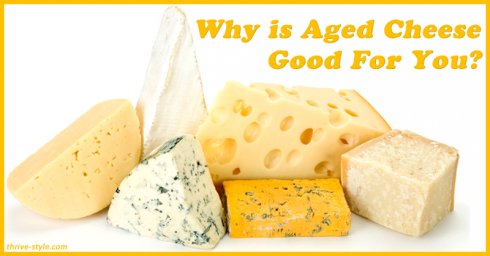
Why is Aged Cheese Good For You?
Benefits:
- High vitamin K2 content (important fat soluble vitamin, contributing to bone health)
- Pasteurization is not necessary because the lactic acid formed during aging destroys pathogenic bacteria but does not harm probiotics – so probiotic content is high. Aged Gouda, cheddar, emmental, and blue cheeses are especially high in probiotics (ricotta and mozzarella are not)*
- 8 beneficial enzymes in raw milk are kept intact during the aging process (for example, the enzymes increase iron absorption and assist fat breakdown)
- Cheddar, Swiss, blue, Monterey Jack, mozzarella, Brie, and Gouda have been shown to reduce the risk of dental cavities
- People who are lactose intolerant can often eat aged cheeses with no problems, as the lactose content is little to none
- Aged cheese contains a high concentration of essential nutrients: calcium, phosphorus, zinc, vitamin A, riboflavin, vitamin B12 and high-quality protein
*”For example, Emmental Swiss cheese contains Propionibacterium freudenreichii, a member of the propionic acid-producing bacteria family. Propionic acid nourishes the cells of the colon and has shown metabolic activity, including lowering blood cholesterol levels, improving blood sugar control, preventing the overgrowth of the yeast Candida albicans, and enhancing calcium absorption. Furthermore, it produces a growth factor that dramatically stimulates the growth of Lactobacillus and Bifid bacterium species, two important health-promoting bacteria.” – Dr. T. Michael Murray
I recommend buying all dairy products in organic form, from pasture-fed cows. This helps the nutrient content of the dairy be even higher—the nutrients from the grass translate to the end product. One compound in particular, CLA, is even known to help with weight loss!
Cheese has gotten somewhat of a bad reputation over the past 20 years—due to its saturated fat content. Now that we are more enlightened in our knowledge about saturated fat (and that it doesn’t actually contribute to heart disease outside of the presence of a high trans fat and/or processed sugar diet), many people can add good quality cheeses to their diet without feeling guilty!
Of course, I don’t recommend consuming crappy non-cheese like Velveeta or Kraft Singles, but I think for people who are not sensitive to cheese (lactose, casein, or otherwise), it can be a great addition to the diet when it is from the highest quality sources.
My friend, Jane, even makes it herself! I definitely want to learn how sometime soon and try it myself.
Are you a cheese eater? Once I realized my body needed more saturated fat to thrive and balance my hormones, I found aged and high quality cheeses were a great addition to my diet. I buy all kinds of fancy cheeses from other countries and from the US…most of the time, I look for raw cheese, but I make exceptions for the really yummy ones, like this one! The aging process helps to restore some of the beneficial compounds that were destroyed during pasteurization.
I’m glad to be adding dairy back in this week. I don’t consume a lot of it, but it is a nice addition to many things I eat!
Thanks for the shout out! I really really hope that dairy isn’t a problem for you! It is so cool reading all those facts about aged cheese!
all i have to say is yes! New Zealand is known for its dairy. Hard cheddar sheeps cheese, local! Best stuff of earth! It’s probably $30 in states and $6 here. HEAVEN!
oh and good on the tummy, thats for sure!
I’m actually not like a huge cheese fan in general. I mean, I like it on certain things, but I hardly ever have it in the house. (I was the kid who picked the cheese off her pizza, and just ate the bread and the sauce!) that said, I’m glad there are some benefits to it!
I find the same thing—I’m satisfied with just a little bit (compared to the past when I definitely thought more was better)!
i hardle ever eat cheese but when i do i look for unpasteurized goat’s cheese or mature goat’s or sheep gouda to grate on an omelette! my boyfriend is a HUGE cheese lover though and Austria is a cheesy country overall!
i’ll be interested to see how you feel with the re-introduction of dairy, lisa!
i agree, a little of a quality cheese far surpasses the mass-produced, typical varieties. i don’t eat huge amounts of cheese, but do enjoy it from time to time. we are lucky: down the street is “vincenzo’s,” like a independent whole foods, and you can buy small pieces of fancy cheeses there!
enjoy your day – and good luck with your goals/work. we have a holiday so i plan to drink coffee and be social!
i did get outside this weekend – i love this winter! (never thought i’d say THAT!).
I ocassionally have a little goat cheese, but cows milk in all forms makes me lethargic and congested. I hope your body continues to handle the dairy. 🙂 Went for a long walk this weekend- I wanted to go for a ski, but ran out of time.
Glad you’re loving the yoga still! I ADORE aged cheeses. High quality cheese is a thousand times better than the usual “cheddar” that you see on party platters and such. One of my fave things to order at restaurants is a cheese plate of local cheeses – luckily several restaurants in my area offer that. I also love raw milk cheese. I got to try some at a farmer’s market and it was fantastic!
My goals for this week are to get back on track with work and things around the house since I was sick these last few days!
I’m a cheese eater, but don’t eat it everyday. I now only purchase organic cheeses and dairy products. Since I’m pregnant I’m suppossed to stay away for raw milk & cheeses, but it’s something I want to learn more about after. Although you already taught me a lot!
I LOVE cheese! 🙂 I tend to gravitate toward very pungent cheeses (like blue, very sharp cheddar, and epoisses). I would love to learn how to make my own — that sounds amazing!
I eat a little cheese- SO good! Since I gave most forms up while preggers with Kay and then after (once I found out SHE was lactose intolerant), I have brought it back in a bit since I’m not longer bfeeding her. Cheese is awesome. I didn’t know that about the cheap cheese products, but I figured there was a bad reason for why it was so cheap. Goals for this week- spend lots of time with Kay, help her work on crawling!
So far…the dairy seems like it’s working for me. I think I’ll just keep it in as an accessory, instead of supersizing it like Americans do with most things!
Cheese is my favorite food. Of all time. I stick to high-quality cheeses, too, and either aged or really creamy expensive soft ones 🙂 I’d so much rather eat a little bit of high quality cheese, than eat more of cheap, low quality “cheese.”
So far on day 3 of eating dairy, everything is A-OK…so I’m pretty happy about that. It would be a sad world for me with no cheese in it! Especially when I start to take the time to make it myself—I need to study your posts about it!
Stock up on cheese while you’re there! I buy a lot of the imported stuff here, and it is quite costly…but hey, you can’t put a price on quality/health!
Oh my gosh, you’re so right! I have never had a digestion issue with cheese…and that’s more than I can say for most things!
I just tried a goat gouda on my eggs this morning that was AMAZING! Goat and sheep are definitely my faves!
Ooooh, Vincenzo’s sounds like my kinda place! One time I did a cheese tasting when I was on a wine tour….it was like heaven 🙂
I wouldn’t mess with the recommendations for what not to eat during pregnancy either…but it does make me chuckle a little. The only cases of death from dairy products came from pasteurized ones….raw milk and raw milk cheese come packages with their own protection…but the government decided it was dangerous (or the dairy industry did, and convinced the government). So theoretically, the raw dairy is actually safer and healthier…but I am totally with you—when you’re pregnant, there are some things you just don’t want to experiment with!
So interesting Lisa! Same thing with the whole lunchmeat thing. Have women really gotten ill from it? I don’t really each lunchmeat so it doesn’t matter to me.
Cheese is my fave 🙂
I’ve often cut it down to goat/sheep cheese too, since I know it’s more easily digested…I’m happy to be finding out that I’m not having issues with cheese though!
I just started aged gouda cheese as I am eliminating sugar & carb due to high blood glucose.
I am eating a diet of mixed keto, carnivore, no sugar no carb diet. I added aged cheese so I wont go hungry so soon.